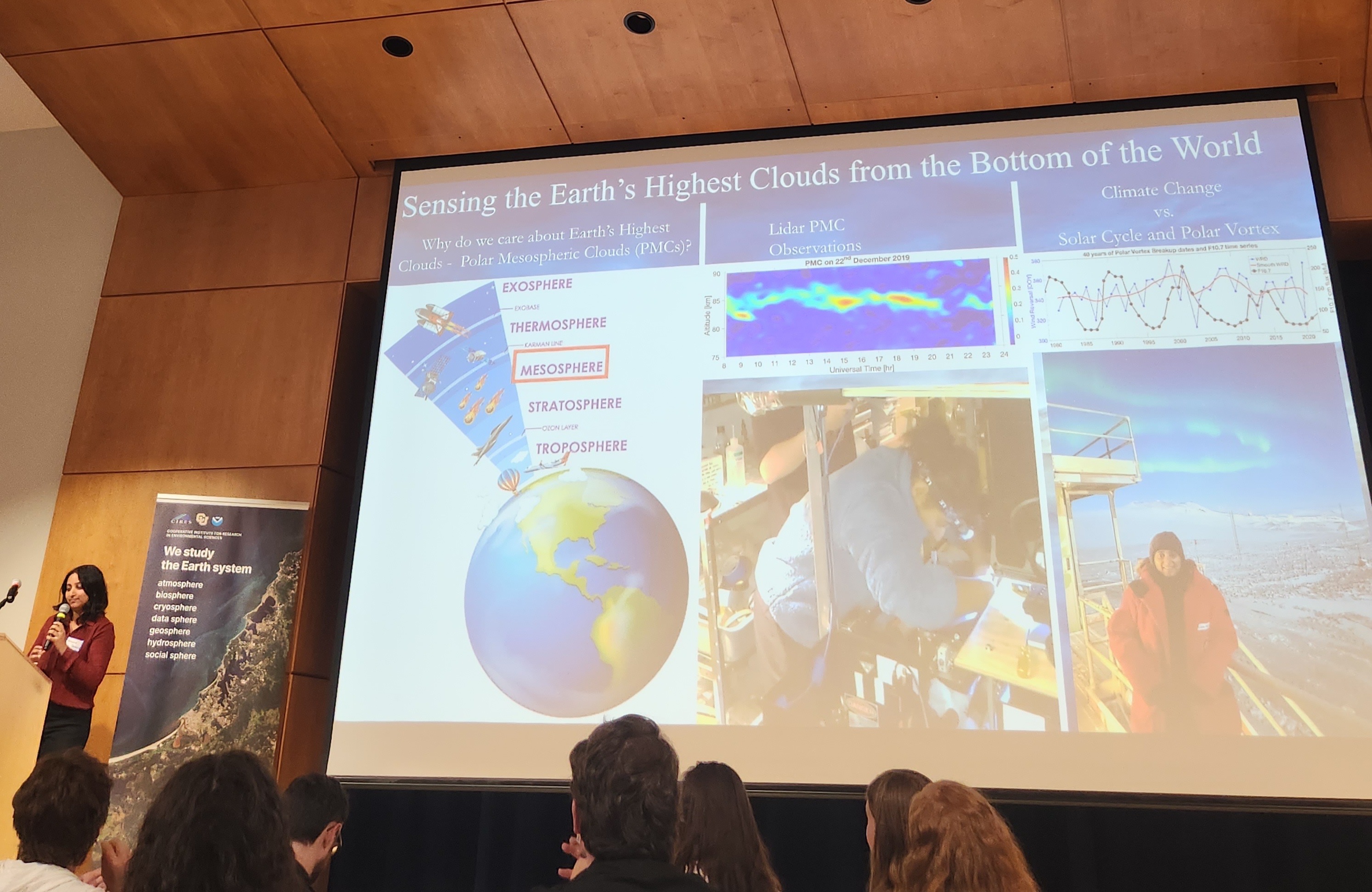
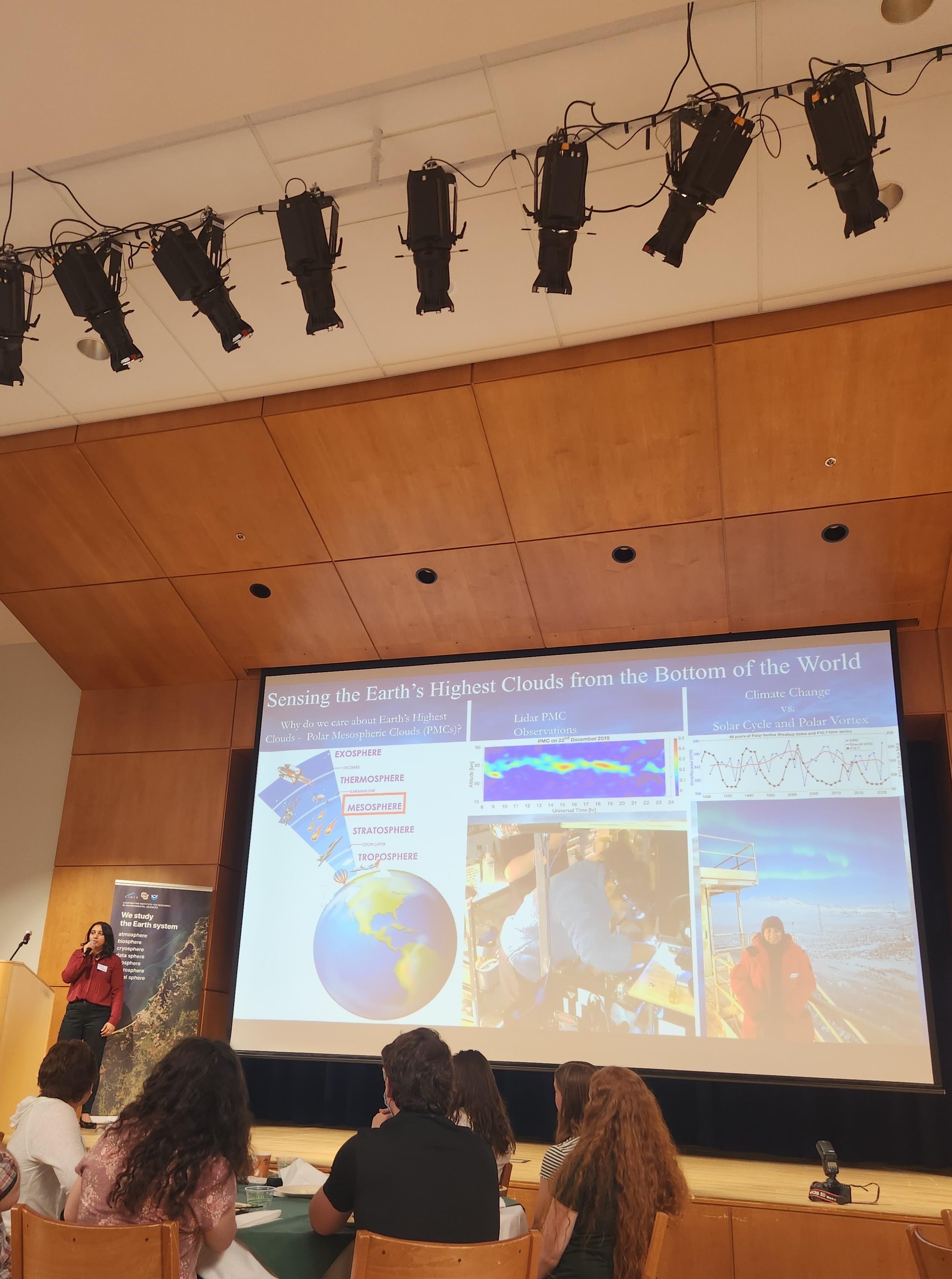
Presenting "Sensing Earth's Highest Clouds from the Bottom of the World" at the CIRES Lightning Talk series
Background
I study polar mesospheric clouds (PMCs) – clouds that form in one of the most unique and puzzling environments found only in the polar summer. The constantly sunlit summer polar mesopause is the coldest region between the Sun and Mars, leading to supersaturation of water vapor and cultivating an environment that forms and sustains the highest clouds on Earth – PMCs, also known as noctilucent clouds.
"It has been proposed that PMCs are a potential early indicator of climate change. So, how can these clouds help us detect climate change?"
CO₂ causes warming in the lower atmosphere while it causes cooling in the upper atmosphere. Water vapor is also expected to increase in a warmer climate. Both these conditions are expected to cause an increase in PMCs. But other factors like polar vortex and solar cycle could also affect PMCs. My research focuses on identifying and understanding the driving forces behind PMC changes.
My Work
I work in the Chu Research group, and we employ highly sophisticated UV Lidar and visible Lidar to explore the upper atmosphere in Antarctica. My role is very multi-disciplinary – spanning both science and engineering!
I characterize PMCs that form over McMurdo, Antarctica, as well as establish their long-term trends using PMC observations from the lidar along with satellite observations of PMCs. During my time in Antarctica, a typical day started with a harrowing drive to the observatory through high winds over snow drifts in the dark without headlights to avoid scattered light interfering with the instruments.
Once safely inside, my work could include anything and everything between assisting Dr. Chu in laser installation, repair, and refurbishment, to operating the lidars, tuning the lasers, and data collection. I spent 6 months in Antarctica leading the lidar campaign and collecting invaluable data for our research.
Key Findings & Implications
While climate change is expected to play a role in PMCs, there are two other factors that could dominate PMC variability: the solar cycle and polar vortex breakup timing.
Increased solar flux would cause a decrease in water vapor due to photolysis, resulting in fewer clouds. Earlier vortex breakup would cause a longer summer, more water vapor and lower temperatures, leading to more PMCs.
"From our studies we found that the polar vortex breakup timing plays a major role in PMC formation, with an earlier breakup time leading to stronger and brighter PMCs. The effect of the solar cycle on PMCs was found to be much less significant."
During the years 1981-2002, the PMC variability was largely attributed to solar cycle signature. However, my work shows that the polar vortex breakup timing coincidentally happened to be in-phase with the solar cycle during this period, giving an illusion of a strong solar cycle impact on PMCs. To strengthen the argument, in the other years when these two are out-of-phase, we don't see a solar cycle signal in PMCs.
Circling back to climate change – as we move into a warmer climate, who knows if climate change could someday overpower the dynamic forces impacting PMCs. Given this, it is really important to have a long dataset to study the influence of climate change on PMCs. The measurements collected from McMurdo Station continue to contribute to this critical research.